Roof leak in your attic: when to call a pro
The stain on your ceiling is rarely above the leak. Here is what to look for from inside the house, what a professional inspection covers, and when to stop watching and call.
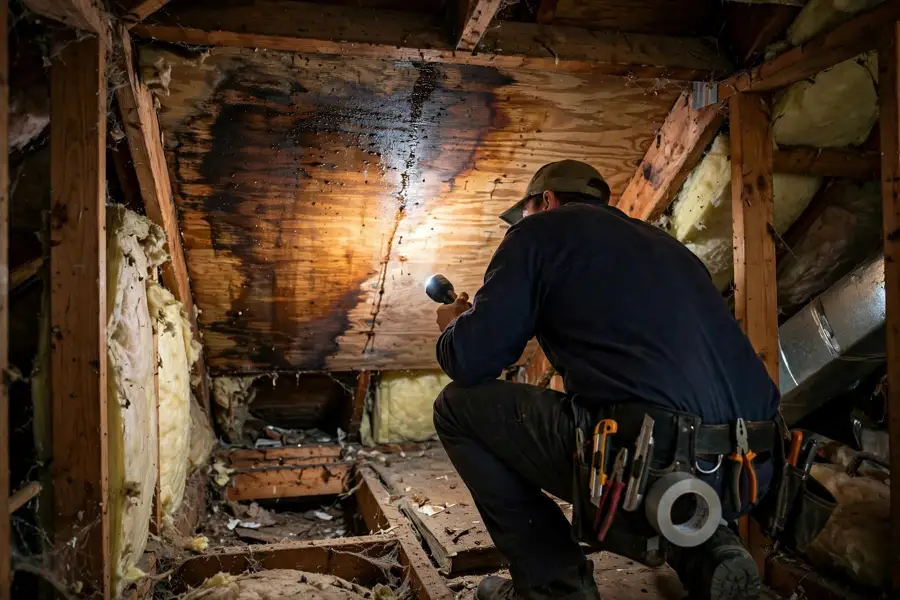
You find a brown ring on the ceiling and look straight up. The leak is rarely there. Water enters at the roof deck, runs down a rafter or along the sheathing, and drips several feet away — sometimes in a different room. This post is not a do-it-yourself repair guide: getting on a Houston roof, or into a 140–160°F attic, to chase a leak is how people get hurt and how small leaks become big ones. It is a guide to what to look for from inside, what a professional inspection covers, and when to stop watching and call.
What to look for from inside the house
Look for a stain that grows after rain, paint bubbling or peeling on a ceiling, a musty smell in a room that was dry last month, and damp insulation visible from the attic hatch — without climbing in. Note when the stain appeared and whether it only shows after hard, wind-driven rain. Wind-driven rain forces water into places gravity-fed rain does not reach, which usually means a flashing gap or a failed seal at a penetration. Write down the date, take photos from the floor, and keep the photos: they are the start of the documentation your insurer will want if the leak came from a storm.
Where Houston attic leaks usually start
Most attic leaks we trace come from a small list: failed pipe boots, wind-driven rain at valleys, flashing around chimneys or skylights, nail pops, and wind-lifted shingles. The ceiling stain tells you where water exits; the attic tells you where it entered. In Montrose, pre-1980 bungalows with gable or box vents only — well short of balanced ridge-to-soffit ventilation — can rot decking from the inside without any visible interior staining at all. In EaDo, legacy stock with original vents and Houston humidity above 75% has the same problem. A stain is a symptom; the source is a roof-system failure, and finding it takes a slope-by-slope inspection, not a glance at the ceiling.
What a professional inspection covers
A roof inspection photographs every slope, checks flashing, valleys, pipe boots, skylight curbs and nail pops, and checks the attic where there is safe access — looking for damp decking, daylight, and ventilation shortfalls. The report should name the source, not just the stain, and it should say whether the fix is a repair or a replacement. If the leak is active water coming in now, that is an emergency roof repair: buckets, photos, and a call, in that order. If it is an old or intermittent stain, it is a roof leak repair inspection.
When to call — and when to call now
Call now if water is actively dripping, if a ceiling is sagging, or if water is near light fixtures or an electrical panel. Call this week if a stain is growing, if it appeared after a named storm, or if the roof is past 20 years old — architectural shingles last roughly 18–25 years in Houston heat and humidity, and a leak on a roof that age is often the first sign the system is done. Do not climb into a hot attic or onto the roof to find it yourself, and do not seal a stain from inside: covering the exit does not stop the entry, and trapped water rots the deck quietly. For the Montrose and EaDo versions of this problem, see our Montrose and EaDo pages.
Get help tracing an attic leak
Stain on the ceiling? Found the leak's trail in your attic? Call (346) 654-5170 and tell us where the stain sits — we trace from the roof surface, not from the stain. Tell us where the stain is and when it appeared, and we will arrange an inspection.