Emergency roof repair in Downtown Houston: what to do first
Downtown Houston is not a shingle market. Here is what to do first when a high-rise flat roof or a parapet-hidden townhome roof fails — and who owns the repair.
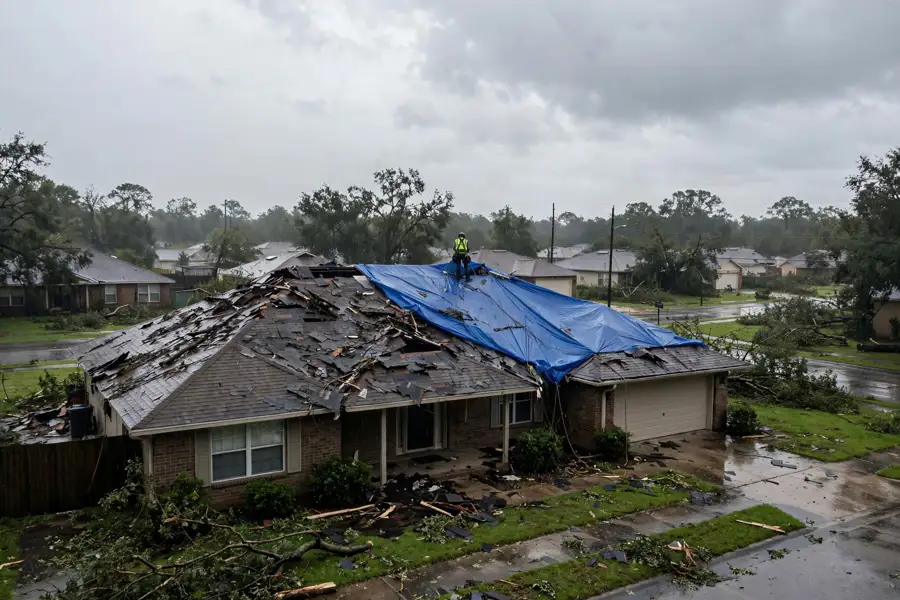
Downtown Houston is not a shingle market. The residential roofing here is almost entirely flat and low-slope: TPO, PVC, modified bitumen and built-up membranes on high-rises and converted lofts, plus parapet-hidden flat roofs on three- and four-storey townhomes at the Downtown edge. An emergency here does not look like a missing shingle. It looks like water ponding against a parapet, a scupper that cannot keep up, or wind-driven rain coming through a curtain-wall and parapet transition. The May 2024 derecho brought straight-line winds of about 100 mph downtown and damaged more than 2,500 windows; one broken curtain-wall panel can let rain into several floors. This post covers what to do in the first hours, and who to call — because in Downtown, that question has two answers.
First: safety, then water
Stay off the roof and out of rooms with sagging ceilings or sparking fixtures. Move valuables away from the drip, put buckets under it, and photograph everything from the ground and from inside before anything is moved or covered. Note the storm date and time. If water is near electrical panels or light fixtures, turn off power to that area and call an electrician — a roofer cannot make an electrical hazard safe.
Tarping is dry-in, not repair
The emergency job is to stop more water getting in: a tarp or temporary dry-in over the failed area. That is not a repair, and it should never be sold as one. On a flat roof, dry-in means covering the failed membrane section and making sure drains and scuppers are clear, because a tarp over a blocked drain just moves the pond somewhere else. Do not let anyone nail through a membrane to hold a tarp down without a plan for the holes that creates.
The Downtown failure: parapet ponding
Standing water against a perimeter parapet wall dissolves asphalt seams and leaks into top-floor bedrooms — that is the most Downtown-specific failure there is. Scupper and drain sizing decides whether a flat roof survives a Gulf Coast downpour, and hail can crack a TPO membrane without leaking for months, so a roof that looks fine after a storm can fail in the next one. A proper emergency inspection checks the membrane, the parapet flashing, the drains and the skylight curbs and rooftop terraces that leak on loft conversions.
Whose roof is it? Ask before you call a roofer
In a 1980s–1990s high-rise tower, the recorded condo declaration typically vests ownership of the building envelope — including the roof membrane, flashing and deck — in the condo association, not the individual unit owner. A leaking membrane can leave the owner below bearing interior-damage cost while the association owns the membrane, and disputes over that boundary can stall remediation for months. Call building management first, then the roofer, and ask for a written scope letter mapping each line item — membrane, insulation, deck, interior drain collars — to the correct ownership category for the board. Our commercial roofing and flat roofing pages explain how we scope that work.
What to do next
Document first, dry in second, and get a roof inspection that photographs every membrane section and drain. If the damage came from a storm, read our storm damage roof repair page before you talk to your insurer, and remember the boundaries: we document damage and provide a written scope — we are not a public adjuster, we do not negotiate claims, and we cannot guarantee approval. For the Downtown location picture, see our Downtown Houston roofing page.
Get help with a Downtown roof emergency
If water is coming into a Downtown building, call Bridgegate Construction LLC at (346) 654-5170. Tell us the building, the floor, and what you are seeing, and we will talk through the first steps.