TPO vs EPDM roofing for flat commercial buildings in Houston
TPO and EPDM are the two flat-roof membranes Houston commercial owners ask about most — and their prices disagree because the scopes disagree. Here is the comparison with every price labelled by scope — and where each membrane actually fits.
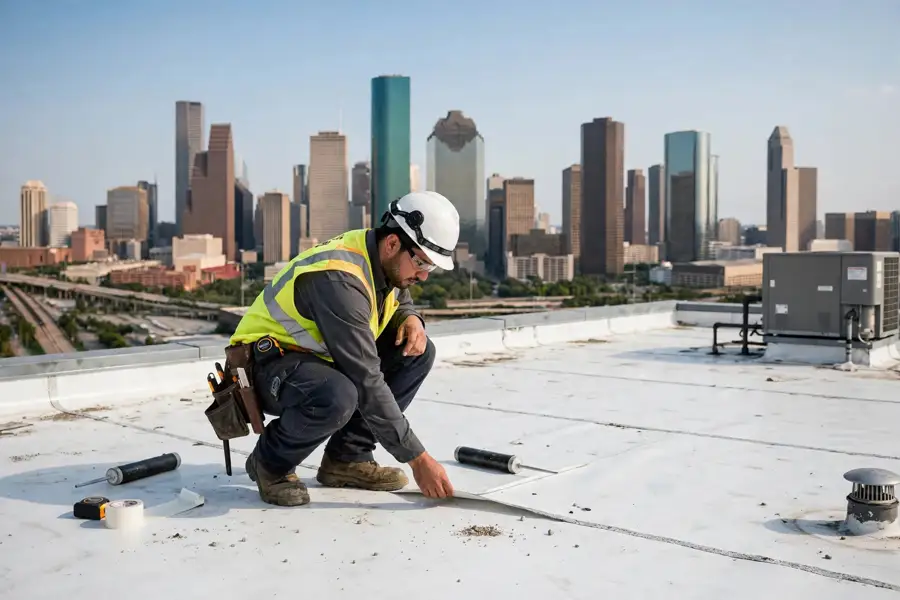
TPO and EPDM are the two single-ply membranes Houston commercial owners ask about most, and their published prices look like they disagree. They do not disagree — the scopes disagree. A residential low-slope TPO price, a Texas commercial system-only price and an all-in commercial tear-off price are three different jobs, and this post labels every price by scope so you can compare honestly. One comparison section, not three thin pages: that is the whole post.
TPO: the white membrane
TPO is a heat-welded single-ply membrane, white and reflective, with solar reflectance above 0.70 — a real argument in Houston heat. It comes in thickness tiers: 45-mil, 60-mil and 80-mil, with a 60-mil TPO lifespan of 20–25 years inside a 15–25-year range. Sourced Houston pricing, labelled by scope: residential and low-slope TPO at $5–$8 per square foot including insulation (45-mil $4–$6, 60-mil $5–$8, 80-mil $7–$10), repair at $300–$2,000, and recover at $3–$6. The Texas commercial system-only figure is $8–$12 per square foot, and the all-in commercial tear-off figure is $14–$20. Same membrane, different job. TPO fits low-slope sections, porches, additions and commercial decks — not pitched residential roofs — and its heat-welded seams require trained crews.
EPDM: the black rubber membrane
EPDM is a rubber membrane, usually black, with a long track record on commercial flat roofs. Its pricing shows the same scope split: M&M Texas/Louisiana puts EPDM at $4–$8 per square foot, while ARP Texas commercial puts it at $11–$16 — different scopes, not an error. PVC, the third single-ply option, shows the same pattern: M&M at $6–$12 against ARP at $14–$20. Modified bitumen, the two-ply alternative, runs $8–$12 in Dallas figures. The lesson is the same in every case: never publish or accept a single per-square-foot number without a scope label.
Which fits your building
TPO fits where reflectivity and heat matter and where welded seams are an advantage — most Houston commercial flat roofs, and residential low-slope sections. EPDM fits where a proven rubber membrane and a simpler install suit the building, and where the owner accepts a dark membrane’s heat profile. PVC fits where chemical and grease resistance matter, such as restaurant roofs. The deciding factors are the deck, the drainage, the parapet details and the budget — in that order, and from an inspection, not a brochure. See our TPO roofing, flat roofing and commercial roofing pages for the system pages behind this comparison.
Drainage first, membrane second
On any flat roof in Houston, ponding is a design and drainage issue, not a membrane issue. Scupper and drain sizing, tapered insulation and parapet flashing decide whether a membrane survives a Gulf Coast downpour. A new membrane over a ponding deck is money wasted, and a recover over wet insulation is worse. The inspection should map ponding, probe the deck, and scope drainage before it scopes membrane.
Get help scoping a flat roof
Flat roof to scope? Choosing a membrane for a flat commercial roof? Call (346) 654-5170 and we will scope the seams, drains and deck for your building. We inspect membrane, insulation and drainage as one system.